
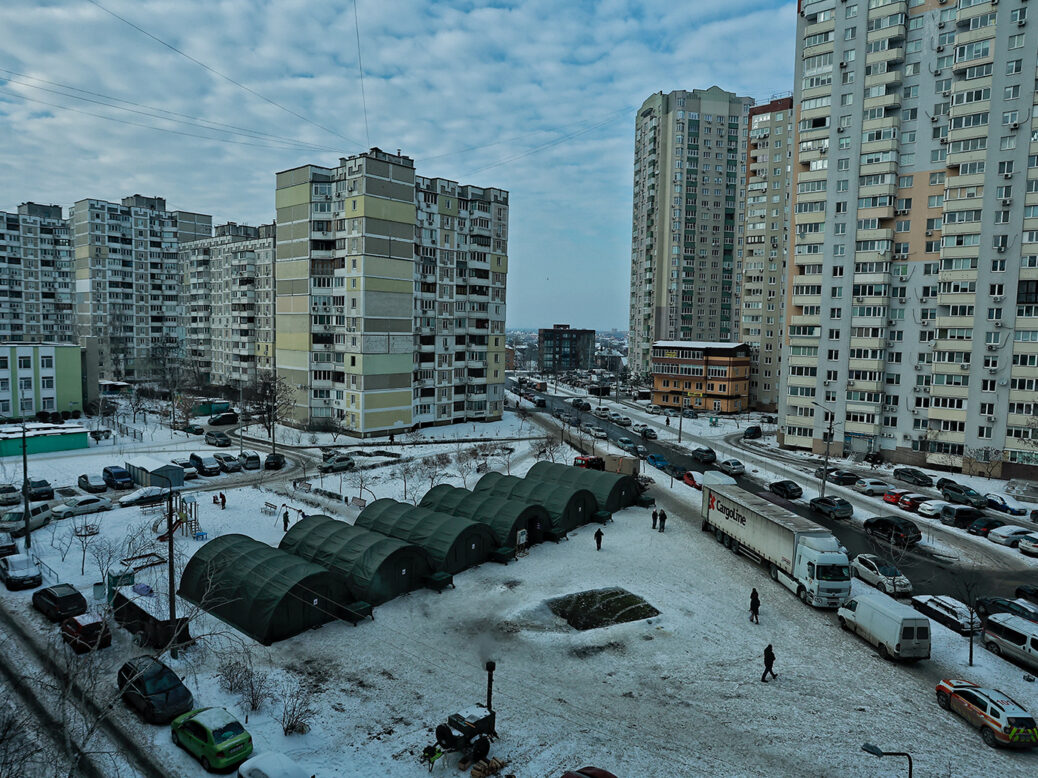
Day 1,513 of the invasion. 16 April, 2026. Kyiv, 2am. The air-raid siren wails, instantly followed by blasts. I scramble to wake up my girlfriend, Dasha, pulling her from the bed. Entangled in our blankets, we bolt for the hallway, desperate to put distance between ourselves and the glass balcony. The explosions are so violent that I am bracing myself for a shower of shrapnel, making sure we are staying low. Shiva, our six-month-old Shiba Inu pup, is treating our midnight running around as a curious new game.
My heart hammers frantically, as if desperate to finally break free from its ribcage. After years of invasion, we have come to know the pattern: this rush of adrenaline will inevitably be followed by a downward depressive slump. Throughout the day my heart will maintain a rhythmic “shelling tachycardia” – a haunting vibration, as if it has been jolted from its place and can no longer fit into its usual cubbyhole.
We are standing in the hallway, holding our breath. Smiling bitterly, I recall that only a few hours ago I was watching a video of US Vice-President JD Vance’s proud announcement that the Trump administration had halted aid to Ukraine. The natural logic of the world has become so warped that nothing should come as a surprise any more. And yet, the reminder that we might have been left one-on-one with the Russian monster hits hard.
Another wave of explosions. A barrage of enemy drones and missiles. The windowpanes rattle violently from the work of our air defences. I open the news feed – Kharkiv, Odesa and Dnipro are also under fire. Direct hits on high-rise residential buildings and civilian infrastructure. Wounded and dead.

A few days ago, Dasha and I travelled to Chernivtsi – one of the country’s safest havens, nestled near the Romanian border. We went to visit my parents to celebrate Orthodox Easter. My parents are professors and scholars of literature, both in their seventies. Yet, their lives were shattered at the onset of the Russian invasion; they spent nearly three weeks trapped in occupied Bucha, where their home was once a sanctuary.
Since their evacuation in mid-March 2022, my mother has not set foot in Kyiv or in Bucha. They have been stuck in the limbo of an unresolved question: when will it finally be safe to return? Or should they simply give up and try to plant roots in the tiny house in Chernivtsi that has become their temporary shelter? In the past, at every family gathering, this question would inevitably arise: “Well? Shall we start planning our return?” My father would always add that things seemed to be moving toward the freezing of the front lines and the signing of some kind of agreement.
Yet, over these years, I have developed a formula – a way to maintain at least a semblance of sanity and a very tenuous planning horizon in a reality where planning is fundamentally impossible. To my parents’ repeated questions, my answer is always the same: “I don’t know what the experts are telling you, but for the next six months, the invasion will continue.” This is a given in our lives, the very basis of our existence.
The questions from my parents had grown especially urgent over the last year and a half, as the president of the United States had been proclaiming, almost daily, a commitment to the fastest and most effective ceasefire possible. Western journalists, too, have asked the same question countless times: “Do you not feel that the invasion is nearing its end?”
No, I do not. The Trump team sold the world a promise: an end to the war. For months, they spun an illusion of an impending peace deal. And it seemed that the world was more than willing to buy it – as if to say, “Stop focusing on Ukraine; they’ll figure it out.” But the illusion of a deal is not the real deal. The illusion of a deal does not stop Russia from its daily, methodical extermination of Ukrainians and our land. And then came August 2025. Anchorage. I looked at my parents and said: “You’ll be staying in Chernivtsi for a long time.”
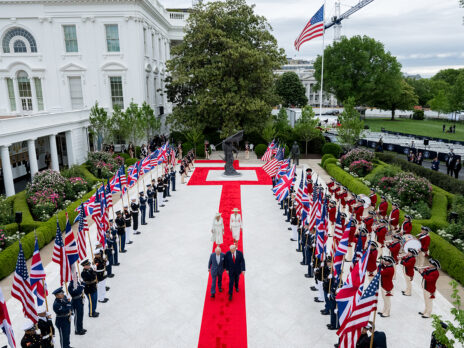
The meeting between Putin and Trump gifted Russian propaganda a handy new term: the “Spirit of Anchorage.” It was meant to signify a “thaw” in Russian-American relations. Yet, the Spirit of Anchorage is something far more profound. It is the world order being reconfigured right before our eyes. In truth, the Spirit of Anchorage is the sight of the US military on its knees, rolling out the red carpet for a Russian dictator. It is Russian evil remaining unpunished. It is an invitation back to the table of global politics to get a slice of the great cake of power.
On the road to the promised peace deal, it is far easier to pretend that there was no act of unprovoked aggression; that there were no Russian war crimes or mass graves of Ukrainians; that there was no systemic torture or the annihilation of our civilian infrastructure. These are dismissed as mere “oversights” by overzealous subordinates, while a “strongman” ruler takes by force what he believes is rightfully his.
Russia understands only strength. To Russia, diplomatic overtures are a symptom of weakness. Thus, the Spirit of Anchorage is a green light for the sabotage of Nato and the onset of a hot phase of hybrid warfare, designed to sow chaos throughout Europe’s security structure. The primary objective is to repeatedly place Nato in positions that breed internal discord – until the question “Does this trigger Article 5, or not?” eventually becomes purely rhetorical.
Between 2022 and February 2026, Russia executed more than 150 operations across Europe. Arson attacks on warehouses and factories, railway sabotage, drone provocations, GPS jamming, cyber offensives, and the recruitment of youth via Telegram for acts of terrorism. Ukraine has lived through all of this before, which is why what is happening now is so painfully obvious to us. For instance, following the onset of Russian aggression in Donetsk and Luhansk in 2014, Russian saboteurs detonated at least four major ammunition depots, methodically eroding the country’s military potential – all the while presenting these strikes as mere accidents.
The Spirit of Anchorage is a world where the democratic community is forced to seriously debate the defence of Greenland against a Potus who aspires to be both king and pope. The Spirit of Anchorage is when the United States casts its vote alongside Russia against an International Atomic Energy Agency resolution condemning Russian attacks on Ukraine’s power grid. The Spirit of Anchorage is the mobilisation of a global network of authoritarian leaders, emboldened to block democratic initiatives and openly broadcast pro-Russian rhetoric – or, worse, to become an outright threat to their neighbours.
This echoes the events of 2025, when the Security Service of Ukraine (SBU) exposed a Hungarian intelligence officer operating a Budapest-run spy network in Ukraine’s Zakarpattia region, which borders Hungary. Two operatives were detained for collecting intelligence on the region’s defence capabilities and gauging the local population’s potential reaction to an incursion by Hungarian troops. Let me repeat that: they were assessing locals’ perspectives on a potential invasion by Hungarian forces into a sovereign country already being torn apart by Russian aggression.
The Spirit of Anchorage is the streamlining of smuggling routes that deliver foreign components for Russian Shahed drones. For instance, American components manufactured as recently as 2025 were discovered in the drones used to attack Ukraine in March 2026.
The Spirit of Anchorage is a world where international politics has become nothing more than a reflection of corporate interests. It is a system where a head of state’s policy decisions trigger stock market manipulations by his inner circle. And where access to state secrets – such as the impending arrest of a foreign leader – is treated as an opportunity to place bets on Polymarket.
Fifteen hundred days have passed since the beginning of the invasion. For nearly a third of that time, the promise of a sustainable peace has dominated the global agenda. Yet this promise of peace – in the paradoxical fashion of Orwell’s “war is peace” mantra and Trump’s rebranding of the US Department of Defense as the Department of War – only heightens the anticipation of a global conflict.
Western journalists ask: “Do you feel that the Russian invasion is nearing its end?” And every time, I am forced to reply: “No.” We are only nearing the end of the first act of a global play in the theatre of war. North Korean mercenaries are already fighting on our soil – to say nothing of the ethnic groups forced into service by Russia, or the recruitment of mercenaries from across Africa. We are bombarded by Iranian and Russian drones, packed with components sourced from every corner of the globe.
Trump is establishing economic and political dialogue with the Belarusian dictatorship – a regime that remains unpunished despite serving as the launchpad from which Russian troops invaded my home, the Kyiv region. The blood of Bucha is on their hands as well.
The entire world is aware of Russia’s “shadow fleet.” Israel continues to purchase grain plundered from Ukraine. And Russian oil is allowed on the market. Mercenaries from 48 countries who fought on the side of Russia are currently being held in captivity in Ukraine. At times, it seems that regardless of religion, the world observes only one commandment: “The Art of the Deal”.
Ukrainians are already prepared for the second act of this play. The worst that could have happened to us has already happened.
You can only be blindsided by an invasion once. You can only lose the innocence of not knowing what a full-scale war looks like once. It is vital to accept that, within our lifetimes, life will never return to what it once was. And evil will go unpunished. Humanity seems incapable of learning any lessons, doomed to repeat its mistakes. Yet, it is also vital to remember: goodness must protect itself.
Goodness must know how to shoot and be fluent in tactical medicine. Goodness must not fear being proactive or seizing the initiative. The question is not about faith in the strength of institutions. The question is: when was the last time you were at a shooting range? But the most critical question of all is: what is goodness willing to sacrifice? There is a high probability that whatever you must sacrifice now is still a smaller loss than what evil will eventually take from you by force.
Dawn. I step outside with my dog, Shiva. Kyiv is cloaked in a thick black smoke rising from the fresh wounds carved in the body of the city. These columns of soot are beacons, marking yet another series of Russian war crimes. I look up and think that these pillars of stifling, foul-smelling smoke are the physical manifestation of the Spirit of Anchorage hovering over us.
In this single attack alone, Russia launched 703 aerial assaults on Ukraine – a barrage of ballistic and cruise missiles alongside various types of drones: 121 wounded; 16 dead.
Translated by Maryna Gibson. Oleksandr Mykhed’s books include “The Language of War” (Penguin)
[Further reading: The war with Iran will go on, and on]
Content from our partners



Related
This article appears in the 06 May 2026 issue of the New Statesman, Tis but a scratch
Join the debate
Subscribe here to comment